
Where Coffey County Crime News Appears
The Coffey County Sheriff's Office press-release archive comes first. Posts there appear on no fixed schedule. They follow events. Filters let you sort by year and category. Pursuits, public campaigns, scam alerts, and multi-agency incidents all show up in the mix. Names and photographs are often left out, so read the archive for context rather than as a booking list.
The official archive interface shows how the office organizes its releases:
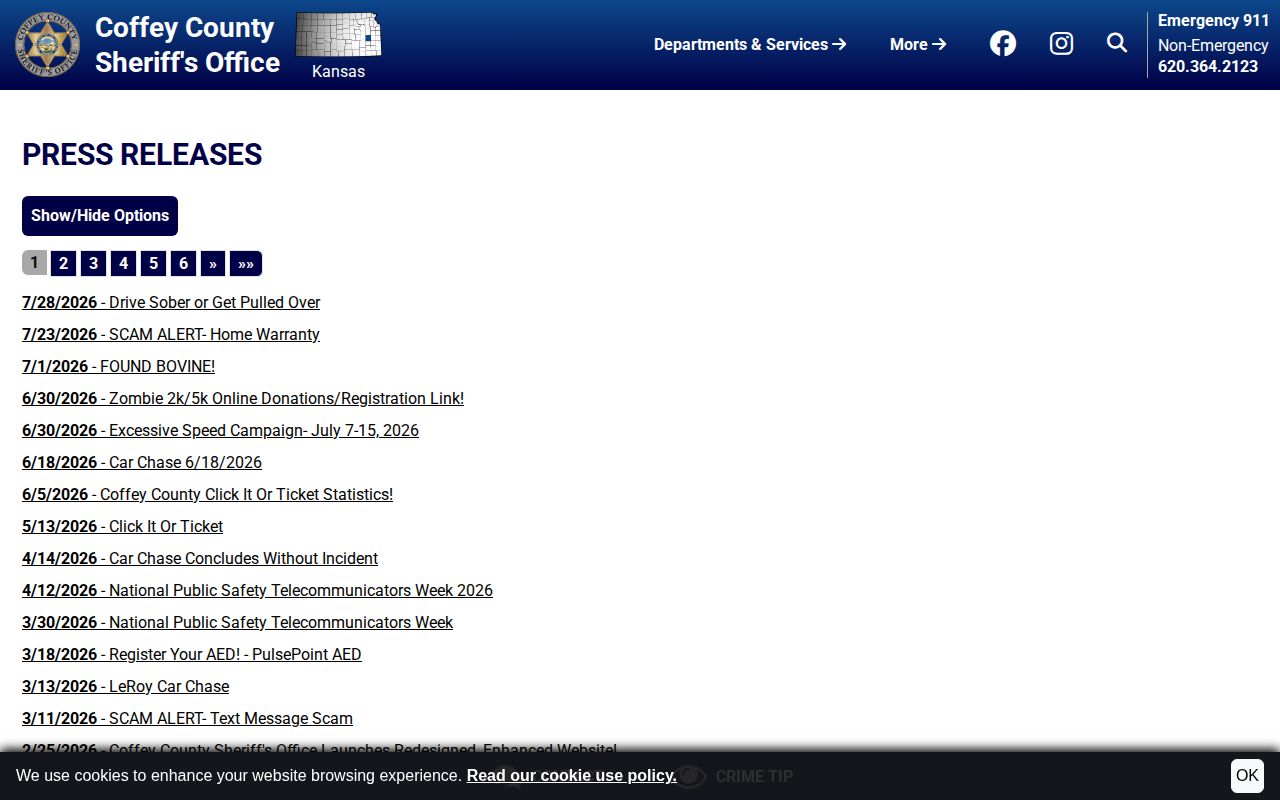
That archive gives agency statements and dates. It is not a full booking feed. The Coffey County Republican fills the inventory role instead. Its Thursday paper and online edition run a "Coffey County Jail Roster" under Public Notices or Courthouse News, and it is the steadiest local custody list around. Plain text, no photos. On the regional side, KVOE and KWCH pick up selected major events, though neither runs a scheduled county blotter. The landscape is layered: official event summaries, a weekly local custody list, and occasional regional coverage.
Coffey County News Source Guide
Work from official material first. News reports then add timeline detail and local color. The last two rows in the guide are private compilations, which can sit stale, miss cases, or lag behind what the court later did.
| Outlet | Coverage | Photos? | Where |
|---|---|---|---|
| Coffey County Sheriff's Office | Irregular official releases on selected incidents, scams, and agency work | Sometimes, but many posts omit names or photos | Press Releases |
| The Coffey County Republican | Weekly jail-roster text plus local reporting | No mugshot gallery in the sample | Paper and online edition |
| KVOE | Episodic Emporia-region coverage of Coffey and Burlington events | May use a sheriff-provided incident image | Story example |
| KWCH | Selected major regional cases | Sometimes uses an agency-provided mugshot | Story example |
| RecentlyBooked, unofficial | Private last-30-days Coffey compilation, including some released people | Its Coffey page says the county does not provide mugshot images | Secondary discovery only |
| Mugshots.com, unofficial | Accumulated Coffey archive, not a current custody count | May retain older imagery or record pages | Archival discovery only |
How Coffey County Photos Reach News
How does a Coffey County photo end up in the news? Three ways: an agency releases it on its own, a reporter requests it, or someone supplies an image tied to one event. KVOE's chase story drew on the sheriff and credited a sheriff image. KWCH's Burlington piece credited a Coffey County Sheriff photo and described Kansas Bureau of Investigation action. Both are story-level sourcing. Neither shows that the sheriff hands out photos for every booking.
The official roster runs on detailed text alone. No detainee images appear there. Under Kansas open-records guidance, basic roster facts and a booking photo are separate items. A mugshot or a standard arrest report can be closed at the agency's discretion. Anyone can ask the records unit for a booking photo. Release is never promised.
No Kansas statute forces a private mugshot site to delete a page or bans pay-to-remove fees. That gap does not hand the public a right to an official image. It raises the stakes on checking sources. Look for the agency credit, tell an incident photo from a booking photo, and verify the record behind the picture.
A photo credit shows where an image came from; it does not establish that the allegation ended in a conviction.
Trace Coffey County News to Court
A reported arrest touches several systems, and each answers a different question. The sheriff's current roster tells you who is in custody now. A separate 48-hour view covers recent releases. Neither adds up to a new-arrest feed. For what prosecutors filed and how a case moved, the court record is the place to look.
- Record the full name, event date, reported agency, and any case or booking number in the story.
- Check the sheriff's current roster for present custody and the separate release view for departure during the stated 48-hour window.
- If the person is absent, do not conclude there was no arrest. Request the booking sheet from the sheriff's records unit.
- Use Kansas District Court Records to locate the Coffey County case, then compare the filed charge with the booking charge.
- Review later amendments, dismissal, plea, trial, judgment, or acquittal entries to reach the disposition.
The county-wide roster and records guide lays out the official custody, release, and KORA request paths in full. Court access can hinge on eCourt availability. A courthouse terminal or a written Judicial Branch request still works as an official fallback. Sealed or expunged records may simply not show.
The Republican's Weekly Jail Record
The paper's jail column is more than a generic mugshot page. The sample names everyone held in the jail during stated days, minus anyone under 18 and anyone protected through a witness program. Fields run from name, age, and residence to custody span, arresting agency, booked charges, status as held, released, or transferred, and bond amount. The paper also cautions that charges logged at booking can differ from the charges later filed.
That caution points straight to the Fourth Judicial District court record. A booking charge is what the jail wrote down. A filed charge is what the prosecutor took to court. A disposition records the outcome. The three can diverge, and a story built on the first one alone can go stale after an amendment, a dismissal, or an acquittal.
The weekly format has limits too. It is not an official sheriff blotter. It cannot prove that every arrest of the week made the column. The under-18 and protected-witness exclusions mean a missing name proves nothing about whether an arrest happened. Kansas juvenile access varies by age and record type, so the paper's editorial rule is a rule of the paper, not a law of the state.
Coffey County News Timing Gaps
Coffey County publishes no same-day booking feed. No weekly arrest list, no 72-hour log, nothing of that kind exists in official form. What the sheriff does offer is a current-custody roster plus a view of people released in the prior 48 hours. Flipping the roster to newest-first won't fill the gap, because a roster is not an arrest record stream.
Quick turnover creates blind spots. Someone booked and released within hours drops out of the official views once that 48-hour window closes. Meanwhile, a person held for months stays listed even though the arrest is old news. The Republican's weekly jail list helps piece together chronology, but it remains a secondary publication. When a stretch of time goes missing, the fallback is a records request aimed at the booking sheet, plus a separate ask for the intake photo if the sheriff keeps one and can release it.
There is no sheriff mobile app. No verified booking-photo social feed exists either. The press archive is worth a look for notable public events, yet it appears irregularly, so its silence proves nothing about whether an incident occurred.
Unofficial Coffey County Archives
Two private pages genuinely cover Coffey County, and both rank behind the official sheriff and court routes. RecentlyBooked claims a 30-day window with multiple updates each day. Its listings can include the booking date, a booking ID, demographics, the arresting agency, charges, and bond amounts, even for people already released. One caveat comes from the site itself: Coffey County does not supply mugshot images, so a generic booking-photo label is no proof a local photo actually exists.
Mugshots.com keeps an accumulating Coffey archive. The county count it displays is neither the jail's current population nor an annual arrest figure. The service also disclaims timeliness and accuracy outright. Treat it strictly as a lead. Then verify against the sheriff and the courts.
No real Coffey County section exists on Busted Newspaper, Arrests.org, or Mugshots.zone. Coffee County, Alabama or Tennessee, keeps surfacing as a false match for Coffey County, Kansas. Guessed URLs and stray statewide hits are not county coverage. If a private page turns out wrong or stale, follow its published free record-maintenance procedure and lean on official court documents. Never pay a fee just because a site threatens to keep someone visible.
Crime Coverage Across Coffey County
The Republican's jail coverage spans all of Coffey County. Burlington, Lebo, Waverly, and LeRoy all appear. Rural arrests and nonresidents show up too. Regional media work differently, zooming in on big events the way KVOE and KWCH did with their Burlington stories. No official city site posts a municipal arrest blotter, which leaves a real gap.
That gap puts weight on the arresting-agency field. The sheriff lists primary services in Burlington, Lebo, and Waverly. Each city also names its own municipal police force. On a jail profile, the agency field is the best tool for sorting out who handled an event. City residence alone tells you nothing. It does not reveal the arresting agency, the filing authority, or where the person was booked.
Keep geography separate from custody and court status. A Burlington dateline does not mean Burlington Police made the arrest. A Coffey County Jail entry could stem from many sources. It might be a municipal sentence, a state agency, a warrant, or a probation and parole matter. It could be another placement or a hold for a different agency. Read the source's exact label. Let the court file settle how the case ends.